Where psychosocial safety meets performance.

Measure psychosocial risk with validated instruments, act early, and hold audit-ready evidence — built privacy-first for modern workplaces.

Built for aged care, education, manufacturing, warehousing & logistics, professional services, frontline teams.

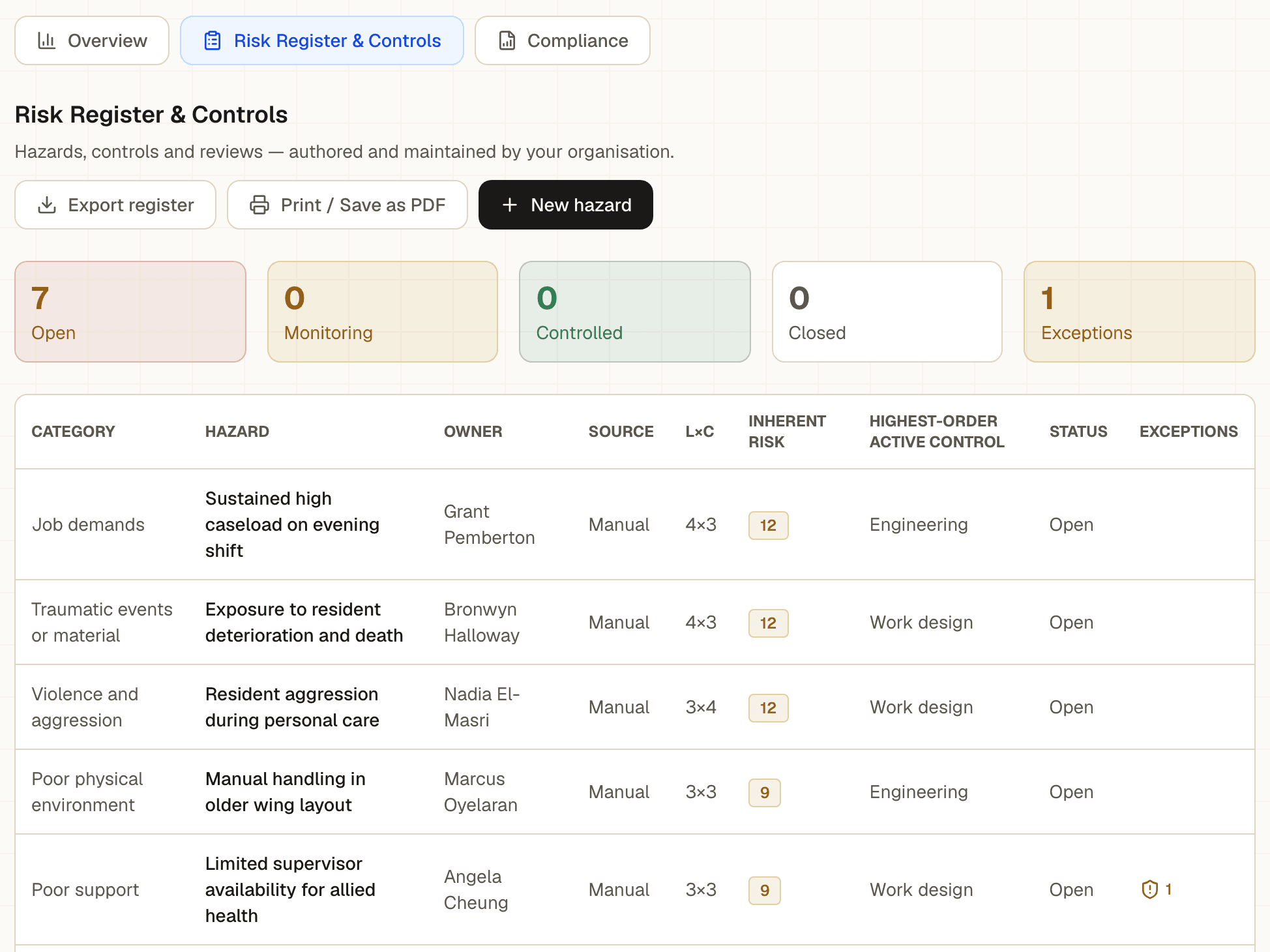
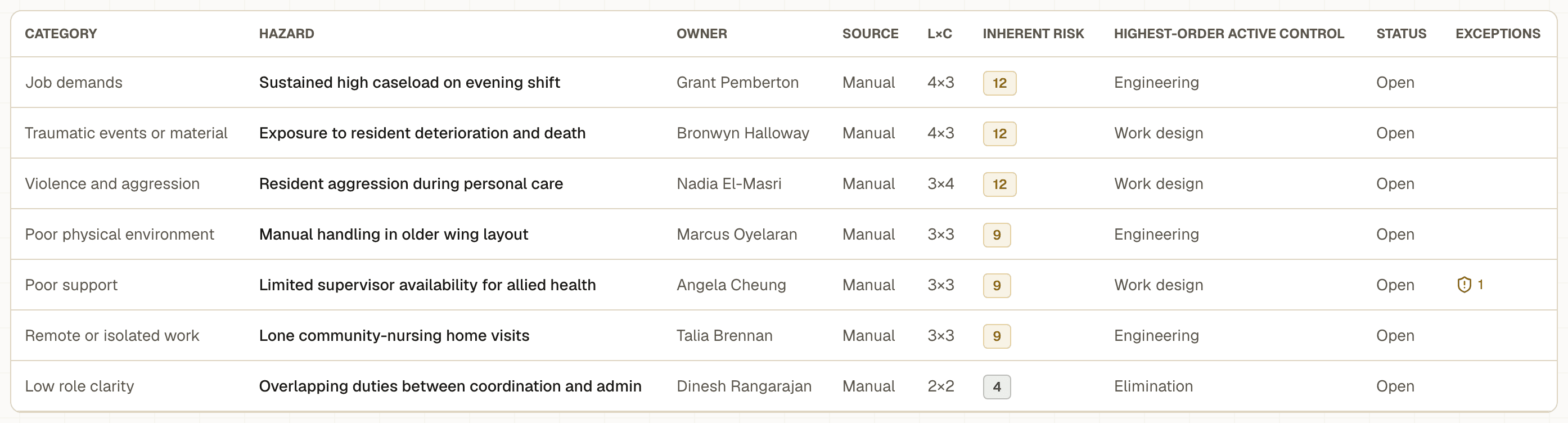
Looping product clip moving through the platform: the organisation overview with its wellbeing, burnout risk and teams-at-risk tiles above an organisational weekly pulse chart; the team analytics view; the WHS Management risk register listing psychosocial hazards with their owners, risk ratings and highest-order controls; then back to the organisation overview.
A single pass through the platform: the organisation view, team-level detail, the WHS risk register, and back to the organisation view.

The duty is already here.

Across the world, psychosocial safety is becoming a measurable legal duty — not a nice-to-have.

161%
Increase in mental health condition claims over the past decade
Safe Work Australia, Key Work Health and Safety Statistics Australia 2025
$67,400
Median compensation for a mental health condition claim — more than 4× the $16,300 median across all serious claims
Safe Work Australia, Key Work Health and Safety Statistics Australia 2025
2 in 3
Workers report burnout
Employment Hero, 2024

From a 60-second pulse to audit-ready evidence.

01

Measure

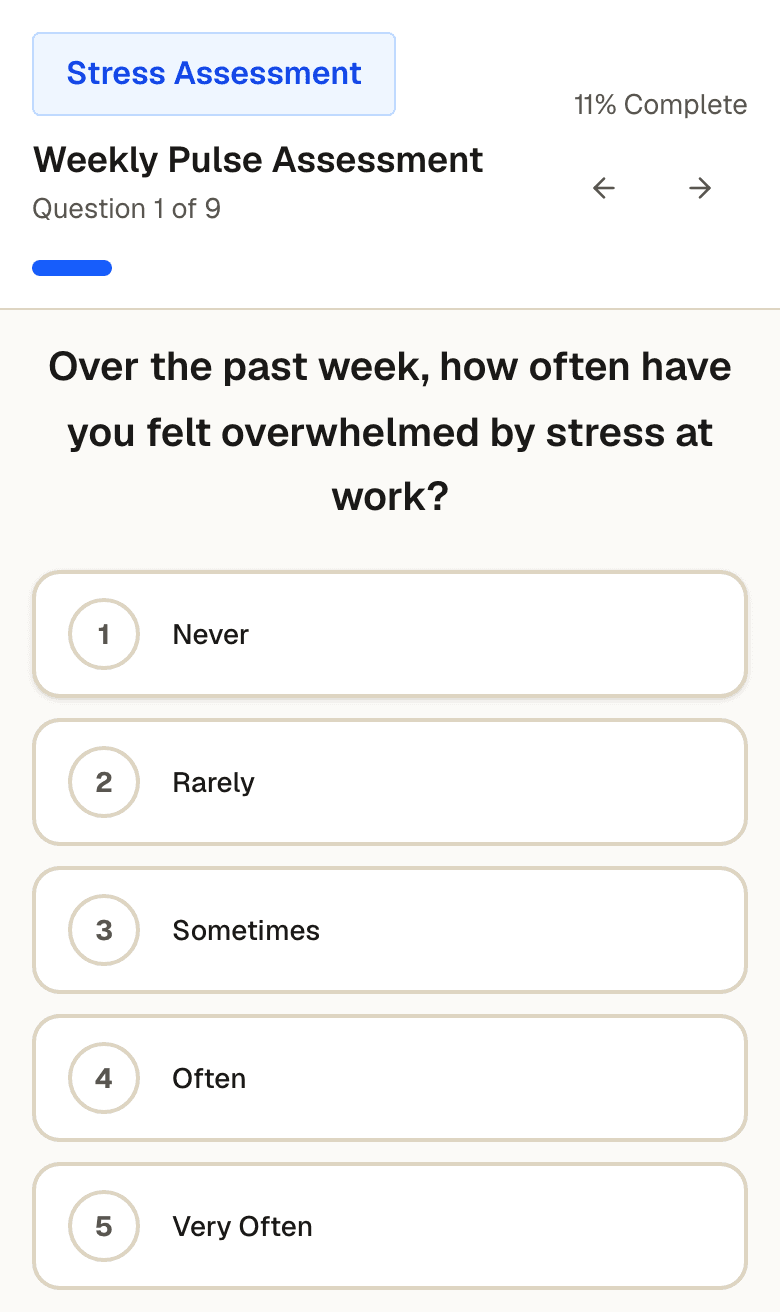
A 60-second weekly pulse of nine items, plus quarterly validated instruments (BAT-23, WHO-5) and a fuller twice-yearly measure of workplace trust, fairness and support from managers and colleagues. Deskless-friendly: it runs on the phone already in their pocket.

A worker's phone showing question one of nine in the weekly pulse — 'Over the past week, how often have you felt overwhelmed by stress at work?' — with five response options from never to very often and a progress bar reading 11% complete.
The weekly pulse — nine items, about 60 seconds, on a worker’s own phone.
02

Understand

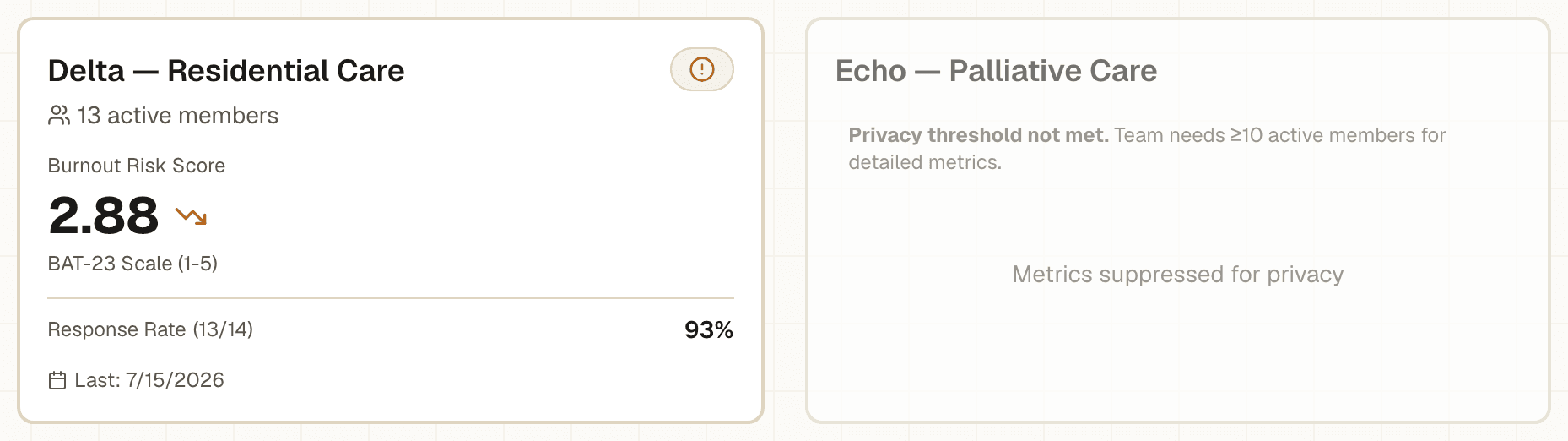
Team-level trends and early-warning signals, aggregated at a minimum group of 10 — never individuals.

Two team cards side by side: Delta — Residential Care, with 13 active members, a burnout risk score of 2.88 on the BAT-23 one-to-five scale, a trend arrow, an amber at-risk marker and a 93% response rate; beside it, Echo — Palliative Care shows 'Privacy threshold not met' and metrics suppressed for privacy.
Two teams side by side — one measured at 13 members, one suppressed below a minimum group of 10.
03

Evidence

Exports a WHS officer can read: hazards, controls in hierarchy order, and a named owner against each one.

The Export Data card: download assessment data in CSV format, with four available exports — weekly pulse, assessment data (BAT-23 and WHO-5), team aggregations and quality metrics.
The export a WHS officer takes to the audit — four CSVs with aggregation thresholds applied.

Proof, not promises.

Validated instruments

BAT-23, WHO-5 and COPSOQ III are published, peer-reviewed instruments in international use — BAT-23 studied across more than twenty countries, COPSOQ available in more than twenty-five languages. We say it precisely: the instruments are validated; we don't dress the platform in their credentials.

Privacy by architecture

A minimum group of 10 — small groups are easy to identify, so we don't show them. Free-text is encrypted at rest, on Australian soil.

Aligned to ISO 45003

The international standard for psychological health and safety at work shapes our access model.

Decision-support, not verdicts

We surface evidence; the judgement stays yours.

Seen every day. Heard for the first time.

Strain compounds in silence until someone leaves. We surface it early — measured properly, without ever exposing an individual.

Running a frontline workforce? Let’s scope a pilot.